Skip to content
Webs 2 PDF Logo
  • Home
  • Benefits
  • Reviews
  • Pricing
  • FAQs
  • Blog
  • Contact
  • Home
  • Benefits
  • Reviews
  • Pricing
  • FAQs
  • Blog
  • Contact
sign in

Author: Abdul Rehman

  • September 16, 2026

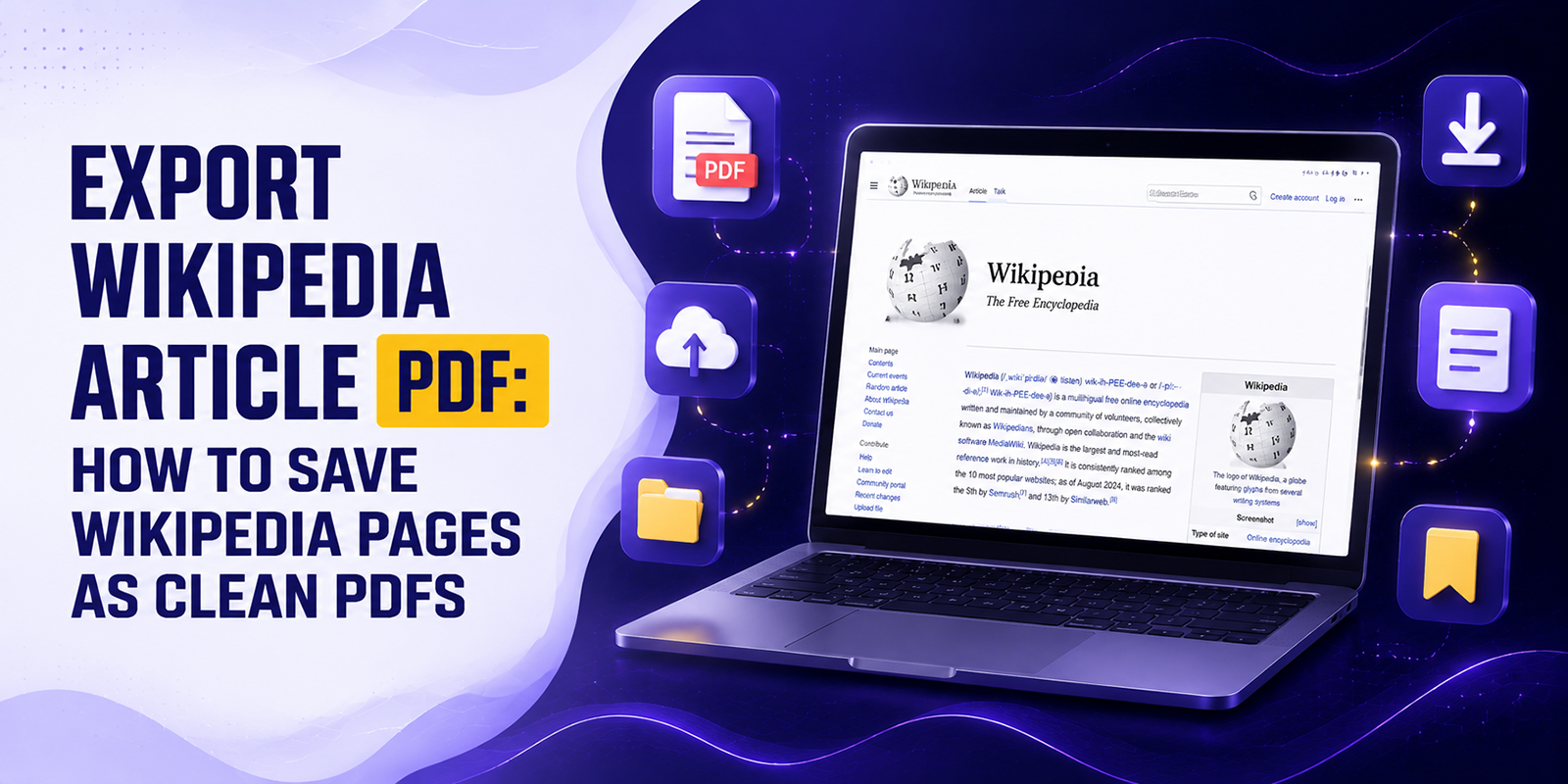
Export Wikipedia Article PDF: How to Save Wikipedia Pages as Clean PDFs

How to export a Wikipedia article as a PDF and save the page for offline reading

Wikipedia is one of the largest knowledge resources available online, covering millions of topics across science, history, technology, medicine, and countless other fields. While reading an article online is convenient, many users need a permanent copy for research, presentations, classroom assignments, or professional documentation.

Learning how to export Wikipedia article PDF files makes it easier to store important information, share references, and access articles without an internet connection.

However, saving a webpage as a PDF is not always as straightforward as it seems. Wikipedia’s built-in export tools may not always provide the formatting users expect, browser print options can create messy layouts, and long articles may lose images or references during conversion.

This guide explains different ways to save a Wikipedia page as a PDF, including built-in options, browser methods, and online PDF converters. You will also learn how to create cleaner documents, properly cite Wikipedia article sources, and use Webs2PDF.com to generate professional-looking PDFs quickly.

What Is Wikipedia PDF Export?

Wikipedia PDF export is the process of converting a Wikipedia article into a downloadable PDF document. A PDF version preserves the article’s text, images, references, and formatting so users can read or share it outside the Wikipedia website.

Wikipedia provides its own PDF creation feature through the “Wikipedia Download as PDF” option available in the sidebar or export menu on supported pages. This feature creates a printable version of the article without requiring third-party software.

However, Wikipedia PDF export has some limitations:

  • Large articles may take time to generate.
  • Formatting options are limited.
  • Some interactive elements may not transfer properly.
  • Tables and complex layouts may not always appear correctly.
  • The final PDF design may not match academic or professional expectations.

For casual reading, Wikipedia’s built-in option works well. But users who need polished documents for research, education, or professional use may prefer additional conversion methods.

Why Export a Wikipedia Article as a PDF?

There are many practical reasons to export a Wikipedia article as a PDF. Whether you’re a student, researcher, educator, journalist, or professional, saving a Wikipedia page as a PDF makes it easier to read offline, print, share, and reference important information whenever you need it.

1. Offline Reading

Internet access is not always available. Saving an article as a PDF allows you to:

  • Read during travel
  • Access information without Wi-Fi
  • Store research materials locally
  • Create a personal knowledge library

A PDF version keeps important information available whenever you need it. You can also learn how to save web pages as high-quality PDFs for better readability and offline access.

2. Academic Research

Students and researchers often collect background information before writing papers, reports, or presentations.

A Wikipedia PDF can help with:

  • Reviewing information offline
  • Highlighting important sections
  • Organizing research notes
  • Comparing multiple sources

While Wikipedia should generally be used as a starting point rather than a primary academic source, exporting an article to PDF makes it easier to review background information, examine cited references, and identify reliable sources for further research. Students can also learn how to save online content as PDFs when preserving research material.

3. Printing Articles

Many users still prefer physical copies for studying and reviewing.

A properly formatted PDF makes it easier to:

  • Print long articles
  • Add handwritten notes
  • Create study materials
  • Share information during meetings or classes

Using a PDF instead of printing directly from a browser usually produces cleaner results.

4. Sharing Information

PDF files are universally supported across devices and platforms.

You can share Wikipedia PDFs through:

  • Email
  • Cloud storage
  • Learning platforms
  • Internal documentation systems

Recipients do not need special software to open them.

5. Documentation and Record Keeping

Professionals often save online information for future reference.

A Wikipedia PDF can be useful for:

  • Project documentation
  • Internal reports
  • Training materials
  • Historical references

Saving a copy also ensures you can access the information even if the online page changes later.

6. Citation Reference

Researchers often use Wikipedia references to discover reliable external sources.

Exporting an article helps preserve:

  • Article title
  • Revision information
  • References section
  • External links

This makes it easier to review sources when preparing citations.

Methods to Export a Wikipedia Article as PDF

There are several ways to create a Wikipedia PDF. Each method has advantages depending on your needs.

Method Best For Advantages Limitations
Wikipedia PDF option Quick downloads Official tool, simple process Limited customization
Browser Print Basic saving Available everywhere Formatting issues possible
Reader Mode Cleaner text Removes distractions May remove images
Online PDF converters Professional PDFs Better formatting control Requires third-party tools

Method 1: Browser Print → Save as PDF

One of the easiest ways to create a Wikipedia PDF is through your browser’s built-in printing feature.

Steps:

  1. Open the Wikipedia article.
  2. Press Ctrl + P on Windows or Command + P on Mac.
  3. Select Save as PDF as the printer option.
  4. Adjust page settings.
  5. Click Save.

Advantages:

  • Works in Chrome, Edge, Firefox, and Safari.
  • No additional software required.
  • Quick for short articles.

Problems:

Long Wikipedia pages may produce:

  • Broken page breaks
  • Missing images
  • Unnecessary browser elements
  • Poor spacing

For more information, see our guide to browser print-to-PDF layout issues

For simple articles, this method is acceptable. For professional documents, dedicated PDF conversion tools usually create better results.

Method 2: Wikipedia’s Built-In PDF Option

Wikipedia includes its own PDF export feature.

Steps:

  1. Open the Wikipedia article.
  2. Find the Download as PDF option.
  3. Select the PDF download option.
  4. Wait while Wikipedia generates the document.
  5. Download the file.

Benefits:

  • Official Wikipedia feature
  • Includes references
  • Maintains article structure

Limitations:

The generated file may not provide advanced formatting options such as:

  • Custom margins
  • Layout control
  • Branding removal
  • Improved typography

Method 3: Reader Mode

Modern browsers include reader modes designed to simplify web pages.

Reader Mode can:

  • Remove advertisements
  • Reduce distractions
  • Improve readability
  • Create cleaner text layouts

After enabling Reader Mode, you can print or save the page as a PDF.

However, this approach may remove:

  • Images
  • Tables
  • References
  • Article navigation elements

It works best when your priority is reading rather than preserving the complete article. If you need another approach, you can explore ways to convert webpages into PDFs

Method 4: Online Wikipedia PDF Converters

Online converters provide another way to create PDFs from Wikipedia pages. You can use a webpage-to-PDF converter to convert an article directly from its URL.

These tools allow users to:

  • Paste a webpage URL
  • Convert the article automatically
  • Download a formatted PDF

This option is useful when you need:

  • Better formatting
  • Faster conversion
  • Device compatibility
  • Professional-looking documents

Webs2PDF.com: A Simple Solution for Wikipedia PDF Export

For users who regularly need clean PDF versions of online articles, Webs2PDF.com provides an easier conversion workflow.

Instead of manually adjusting browser print settings or dealing with inconsistent layouts, Webs2PDF.com converts web pages into downloadable PDFs directly from a URL.

It can be useful for students, researchers, educators, and professionals who need reliable document copies.

Key benefits include:

  • One-click PDF generation
  • Cleaner webpage formatting
  • Faster conversion process
  • High-quality PDF output
  • No software installation required
  • Works across browsers and devices

Rather than treating PDF creation as a technical task, Webs2PDF.com simplifies the process into a few straightforward steps.

Step-by-Step Guide: Export Wikipedia Article PDF Using Webs2PDF.com

Creating a Wikipedia PDF with Webs2PDF.com takes only a few steps.

Step 1: Open the Wikipedia Article

First, visit Wikipedia and open the article you want to save.

Example:

You may want to save an article about:

  • A historical event
  • A scientific concept
  • A technology topic
  • A famous person

Make sure the page contains the information you need before converting it.

Step 2: Copy the Article URL

Copy the full URL from your browser’s address bar. If you’re working with other webpages, you can also learn how to convert any web page to PDF

Example:

https://en.wikipedia.org/wiki/Artificial_intelligence

This URL tells Webs2PDF.com which page should be converted.

Step 3: Visit Webs2PDF.com

Open Webs2PDF.com in your browser.

The tool works directly online, so there is no need to install applications or browser extensions.

Step 4: Paste the Wikipedia URL

Paste the copied Wikipedia article link into the conversion field.

Double-check that:

  • The URL is complete
  • The page is publicly accessible
  • The correct article is selected

Step 5: Click Convert

Start the conversion process.

Webs2PDF.com processes the webpage and creates a PDF version designed for easier reading and sharing.

Step 6: Download the PDF

Once conversion finishes, download your PDF file.

You can now:

  • Read it offline
  • Print it
  • Share it
  • Store it with your research materials

Tips for Better Wikipedia PDF Formatting

A few adjustments can improve your final document quality.

Choose Portrait or Landscape Layout

Use:

Portrait:

  • Articles
  • Essays
  • Text-heavy pages

Landscape:

  • Tables
  • Charts
  • Wide images

Adjust Margins

Smaller margins can reduce page count, while larger margins improve readability.

For academic documents, balanced margins usually work best.

Use Reader Mode Carefully

Reader Mode can improve text readability, but avoid it when you need:

  • Images
  • References
  • Tables

Remove Unnecessary Headers and Footers

Extra browser information can make PDFs look unprofessional.

A clean PDF should focus on the article content.

Preserve Images and References

For research purposes, always ensure your PDF includes:

  • Images
  • Captions
  • Footnotes
  • References section

These elements improve the document’s usefulness.

How to Properly Cite a Wikipedia Article

If you use information from Wikipedia, follow your required citation style.

APA Style

Example:

Wikipedia contributors. (2026). Artificial intelligence. In Wikipedia, The Free Encyclopedia. URL

MLA Style

Example:

“Artificial Intelligence.” Wikipedia, The Free Encyclopedia, Wikimedia Foundation, 2026.

Chicago Style

Example:

Wikipedia contributors. “Artificial Intelligence.” Wikipedia, The Free Encyclopedia. Accessed September 2, 2026.

Always verify citation requirements from your institution or publisher.

Common Wikipedia PDF Problems and Solutions

Problem Possible Cause Solution
Missing images Browser printing limitations Use a dedicated PDF converter or fix missing images in webpage PDFs
Broken formatting Complex Wikipedia layouts Adjust conversion settings
Large file size Many images and references Compress PDF after export
Missing references Incorrect print settings Use full article conversion
Hyperlinks not working Basic print conversion Use a PDF tool that preserves links

Frequently Asked Questions

Can I export every Wikipedia page as a PDF?

Most publicly available Wikipedia articles can be converted into PDFs. Some pages may have restrictions or technical limitations.

Is exporting Wikipedia articles as PDFs free?

Yes. Wikipedia provides free PDF downloads, and many online conversion tools offer free options.

Is Webs2PDF safe?

Webs2PDF.com is designed to convert publicly accessible webpages into PDF files without requiring software installation.

Does the PDF include Wikipedia references?

Depending on the conversion method, references can usually be included. Full-page conversions typically preserve the references section.

Can I print a Wikipedia PDF?

Yes. PDF files are designed for printing and maintain formatting across devices.

Can I use Wikipedia PDFs offline?

Yes. Once downloaded, the PDF can be opened without an internet connection.

Is Wikipedia PDF suitable for academic work?

A Wikipedia PDF can help with background research, but academic papers should usually rely on sources listed in Wikipedia references.

Can I save Wikipedia pages as PDFs on mobile devices?

Yes. Mobile browsers and online PDF converters allow users to create PDFs from smartphones and tablets.

What is the easiest Wikipedia PDF converter method?

Using an online URL-based converter is often the fastest option because it avoids manual formatting adjustments.

Final Thoughts

Learning how to export Wikipedia article PDF files is useful for anyone who needs offline access, printable documents, or organized research materials.

While Wikipedia provides its own download option, browser printing and manual methods can sometimes create formatting issues. A dedicated conversion solution makes the process faster and produces cleaner results.

Whether you are a student collecting references, a researcher organizing information, or a professional creating documentation, Webs2PDF.com provides a simple way to turn Wikipedia pages into high-quality PDF documents.

Try Webs2PDF.com today and create clean, printable, and shareable Wikipedia PDFs in just a few clicks.

  • September 10, 2026

How to Save a Perplexity AI Answer or Research Thread as a PDF

How to save a Perplexity AI answer or research thread as a PDF using built-in export, Webs2PDF, browser print, and browser extensions.

Perplexity AI has changed how researchers, students, and knowledge workers find information. Unlike traditional search engines that return a list of links, Perplexity reads those sources and synthesizes them into a direct, cited answer. You ask a question, it tells you what the sources say, and it shows you exactly where each claim comes from.

The result is a research thread that can be genuinely valuable: a structured summary of current information on a topic, backed by numbered citations to live sources, often supplemented with follow-up questions and deeper dives into specific aspects of the topic.

But there is a problem. Perplexity threads exist in your account on Perplexity’s servers. They can be deleted. Accounts get switched. Sessions expire. The thread you spent twenty minutes refining into a comprehensive research summary can be gone the next time you look for it. And even if it is not deleted, a live Perplexity thread is not a document; it is a session that cannot be easily shared, printed, cited, or included in a report without first converting it into a stable format.

That stable format is PDF. In this guide, we cover four reliable methods to save any Perplexity AI answer or research thread as a clean PDF, including methods that preserve the numbered citations and source list that make Perplexity’s output genuinely useful as a research document.

Why Save Perplexity Answers as PDF?

Perplexity is not just a conversational AI like a general chatbot. It is a sourced answer engine. Every claim in a Perplexity response is tied to a specific numbered citation. The source list at the bottom of each answer shows exactly which websites, papers, or articles were used to generate that response. This makes a saved Perplexity thread functionally different from a saved ChatGPT conversation; the citations give it evidentiary weight that a general AI response lacks.

  • Research documentation. Researchers and students who use Perplexity for literature reviews, background research, or source discovery need a stable, citable version of their research threads. A PDF with preserved citations is a research document; a live Perplexity URL is a session that may expire.
  • Sharing without requiring a Perplexity account. If you need to share your research with a colleague, supervisor, or client who does not use Perplexity, a PDF is universally readable without any account, app, or subscription.
  • Offline reference. A PDF is accessible without internet. For researchers working in libraries, archives, field locations, or international environments with unreliable connectivity, archiving web pages as PDFs can provide a practical offline reference.
  • Inclusion in reports and presentations. A Perplexity thread cannot be embedded in a Word document, PowerPoint, or formal report. A PDF can be appended, linked, or referenced as a source document in formal deliverables.
  • Account switching and thread loss prevention. Perplexity threads in your Library can be lost when accounts are deleted, plans change, or sessions are cleared. A locally stored PDF is permanent regardless of what happens to your Perplexity account.
  • Academic integrity trail. For students and academics, preserving the exact research session, including what sources Perplexity used at a specific moment, creates a documented audit trail for the research process.

What makes Perplexity research threads uniquely valuable

Unlike general AI chatbots, Perplexity anchors every factual claim to a numbered citation with a live source URL. A saved Perplexity PDF therefore functions as a research summary with a bibliography, something you can cite, verify, and share as a documented starting point for deeper research. This is why citation preservation is the most critical feature when choosing a method for saving Perplexity threads as PDFs.

Method 1: Perplexity’s Built-in Library Export (Best for Citation Preservation)

Perplexity introduced a native thread export feature in its Library panel. This is the most reliable method for preserving the structured format of a research thread, including the numbered citations and source list, because it is generated directly from Perplexity’s own data rather than a browser render.

How to use Perplexity’s built-in PDF export

  1. Open Perplexity at perplexity.ai and make sure you are logged in to your account.
  2. Click Library in the left sidebar to open your saved research threads.
  3. Find the thread you want to export and click on it to open it.
  4. Click the three-dot menu (…) or More options button at the top right of the thread.
  5. Select Export as PDF from the dropdown options.
  6. Perplexity generates and downloads the PDF directly to your device.

What Perplexity’s built-in export preserves

The built-in Library export produces a structured PDF that includes: the original question and all follow-up questions, each answer with numbered citation markers, the complete Sources list at the end of each answer section, any images that appeared in the response, and the thread’s timestamp. This is the most complete citation-preserving export available from within Perplexity itself.

Limitation: The built-in export is only available for threads saved in your Library. If you are on the free plan, Library access may be limited. For threads not yet saved, click the bookmark icon on the thread first to save it to your Library, then export.

Method 2: Use Webs2PDF – No Account Required, Works Instantly

If you do not have a Perplexity account, need to save a thread quickly without navigating menus, or want to convert the full webpage to PDF, webs2pdf is the fastest option. It renders dynamic web pages as they appear in the browser and converts them to PDF in under 60 seconds.

Step-by-step

  1. Open your Perplexity research thread in your browser. Scroll through the full thread to make sure all answers, follow-up questions, and citations have loaded, especially when you are working with long web pages.
  2. Copy the URL from your browser address bar. Perplexity threads have unique URLs that remain stable as long as the thread exists in your account.
  3. Open webs2pdf.com in a new tab and paste the URL into the converter field.
  4. Click Convert to PDF and wait a few seconds for the full page to render.
  5. Download your PDF. The complete thread, questions, answers, and citations as displayed on the page are captured.

Webs2PDF tip: share the thread first for a stable URL

Perplexity allows you to share individual threads via a public link (click Share on the thread). If your thread is set to private, webs to pdf may not be able to access it. Click Share → Copy link to generate a public shareable URL for your thread, then use that URL in webs 2 pdf. This ensures the converter can access and fully render the thread content. You can set the thread back to private after downloading your PDF.

Best for: Quick one-off saves, threads shared by others, users without a Perplexity account, and situations where you want a PDF immediately without going through the Library export flow.

Method 3: Dedicated Perplexity Export Extension (Best for Power Users)

Several Chrome and Firefox extensions have been developed specifically to export Perplexity threads to PDF, Markdown, JSON, and other formats. These extensions are the best option for researchers who use Perplexity daily and need a streamlined, one-click export workflow with full citation preservation.

Top Perplexity-to-PDF extensions

  • Perplexity to PDF (Chrome / Firefox). One-click export of any Perplexity conversation to PDF, Markdown, or JSON. Preserves headers, code blocks, math equations, and full formatting. Also supports batch export of multiple threads. Available on both the Chrome Web Store and Firefox Add-ons. Updated July 2026.
  • ChatExport AI. Exports Perplexity threads to eleven formats, including PDF, Word, Markdown, and Notion pages. Specifically designed to preserve Perplexity’s numbered citation markers and generate a complete Sources block at the end of the PDF. Free Chrome and Firefox extension. Supports Perplexity Pro, Pro+, and Spaces.
  • Perplexity PDF Exporter. Full Library batch export tool. Exports the current thread, selected Library threads, or your entire Perplexity Library as PDFs in a ZIP file. Produces real PDF files with clean filenames. Supports both standard search threads and Computer Mode threads. Updated July 2026.
  • XWX AI Chat Exporter. Adds a floating export button to any Perplexity thread. Click it, choose PDF or Markdown, and the export starts. Specifically noted for preserving citations as numbered footnotes with a Sources list at the end, important for academic and professional research documentation.

How to use a Perplexity export extension

  1. Search for your preferred extension in the Chrome Web Store or Firefox Add-ons. Install it and allow any required permissions.
  2. Open any Perplexity research thread in your browser.
  3. Click the extension icon in your browser toolbar, or look for the floating export button the extension adds to the Perplexity interface.
  4. Select PDF as your export format.
  5. The extension processes the thread and downloads the PDF to your device.

Why extensions preserve citations better than browser print

Perplexity virtualizes long threads; older answers in a thread only load when you scroll to them. A browser print-to-PDF will only capture what is in the viewport and what has loaded, potentially missing earlier sections of a long research thread. Dedicated extensions read the full thread from Perplexity’s backend, including all answers and their citation markers, and generate a complete document regardless of what was visible on screen.

Method 4: Browser Print to PDF – Quick but Limited

The simplest option for saving a visible Perplexity thread is browser print-to-PDF (Ctrl+P on Windows, Cmd+P on Mac). If you’re using Chrome, see our guide on how to save a webpage as a PDF in Chrome. For short, single-question threads that are fully loaded on screen, this method works quickly and requires no additional tools.

How to use browser print on Perplexity

  1. Open the Perplexity thread in Chrome, Firefox, Edge, or Safari.
  2. Scroll through the entire thread to load all questions, answers, and citations. Perplexity loads thread content progressively, so scrolling is essential before printing.
  3. Press Ctrl+P (Windows) or Cmd+P (Mac) to open the print dialog.
  4. Under Destination, select Save as PDF.
  5. In More settings, uncheck Headers and footers for a cleaner output.
  6. Enable Background graphics to preserve Perplexity’s styling and citation formatting.
  7. Click Save.

Browser print limitation on long Perplexity threads

Perplexity virtualizes long research threads; earlier answers in a multi-question session only render when you scroll to them. If you press Ctrl+P without scrolling through the complete thread first, earlier sections may not appear in the PDF. For multi-question research threads with more than three or four follow-up questions, use Perplexity’s built-in Library export or a dedicated extension to guarantee complete capture.

Which Method Is Right for You? Full Comparison

Factor Built-in Export Webs2PDF Extension Browser Print
Citations preserved ✓ Complete Partial ✓ Complete Partial
Source list at end ✓ Yes If visible ✓ Yes If visible
Long thread capture ✓ Full ✓ Full render Full May be partial
Account required ✓ Yes ✗ No ✗ No ✗ No
Batch export ✗ No ✗ No ✓ Some tools ✗ No
Mobile compatible ✓ Limited ✓ Yes ✗ Desktop only ✓ Yes
Setup required None None Extension install None
Best for Daily researchers Quick saves Power users Short threads

Who Uses Perplexity PDF Archives and How

University students and dissertation researchers

Students who use Perplexity as a starting point for research, to get a synthesized overview of a topic with citations before diving into primary sources, need a documented record of that initial research session. A PDF of the Perplexity thread serves as an appendix to the research process, showing what sources the AI identified as relevant and what claims they supported. For dissertation students, preserving the research trail is part of academic integrity documentation. Students can also learn more about how to save online content as PDFs when preserving web-based research and reference material.

Journalists and fact-checkers

Journalists who use Perplexity to get rapid background on breaking stories need the ability to document exactly what the tool returned at a specific moment, including which sources it cited. If the story involves contested claims, having a PDF of the Perplexity research thread showing how sources were identified and what they said is part of the verification documentation. Journalists can also archive news articles for research to preserve the source material alongside their Perplexity research.

Consultants and business analysts

Consultants who use Perplexity to research industry data, competitor analysis, regulatory changes, or market overviews need research outputs they can include in client deliverables. A raw Perplexity thread link is not a professional deliverable. A clean PDF with the research question, synthesized answer, and source list is. It can be appended to a report, shared as a research memo, or included in a presentation package.

Medical and legal researchers

In fields where source accuracy and documentation are critical, the ability to save a Perplexity thread with its citations intact is particularly valuable. Medical researchers can document the literature sources Perplexity identified for a clinical question. Legal researchers can preserve the statutes and cases Perplexity cited for a legal query. The PDF serves as a documented starting point for deeper primary source verification.

Pro Tips for Better Perplexity PDF Archives

  • Save the thread URL alongside the PDF. Create a simple text file or spreadsheet entry noting the original Perplexity thread URL, the date of the research session, and the main research question. Even if the thread later becomes inaccessible, you have a record of where the research was conducted.
  • Scroll through the full thread before any conversion. Perplexity loads content progressively. Always scroll from top to bottom of the thread before using webs2pdf or browser print. This ensures all answers, follow-up questions, and citations are fully loaded and will appear in the PDF.
  • Use the built-in export for any thread you plan to cite formally. If your research will be cited in an academic paper, report, or formal deliverable, use Perplexity’s Library export. It produces the most structured, citation-complete PDF that best withstands scrutiny.
  • Name your PDF files with the research topic and date. Perplexity_AIRegulation_EU_2026-09-03.pdf tells you exactly what the thread was about and when the research was conducted. Generic filenames become useless in a folder of fifty PDFs.
  • Capture the Perplexity Pages output separately if you created one. Perplexity Pages is a feature that lets you format a research thread into a structured document page. If you create a Perplexity Page from your research, save that page as a PDF separately from the original thread; the Page format is cleaner and more readable for sharing.
  • For teams: share the PDF, not the thread URL. Perplexity thread URLs require the recipient to have access to your account or a shared workspace. A PDF is universally accessible. For collaborative research, a web-to-PDF workflow for team collaboration can help ensure every team member sees the same version of the research output.

Frequently Asked Questions

Does Perplexity have a built-in PDF export?

Yes. Perplexity has a native PDF export option accessible through the Library panel. Open your Library, find the thread, click the More options (three-dot) menu, and select Export as PDF. This is available for threads saved to your Library and produces the most complete citation-preserving output. Free plan users may have limited Library access; Perplexity Pro users have full Library and export functionality.

Will the numbered citations be preserved in the PDF?

It depends on the method. Perplexity’s built-in Library export and dedicated extensions like ChatExport AI and XWX AI Chat Exporter are specifically designed to preserve numbered citation markers and generate a complete Sources list at the end of the exported PDF. Browser print-to-PDF and webs2pdf.com capture what is visually rendered on the page, which includes citation numbers as displayed but may not produce a separate structured Sources section if that section has not fully loaded.

Can I save a Perplexity thread without a Perplexity account?

If someone shared a Perplexity thread with you via a public share link, you can save it using webs2pdf without needing a Perplexity account. Open the shared link in your browser, copy the URL, paste it into web to pdf, and convert. If the thread is not publicly shared, you need access to the account that created it to export it.

Can I export multiple Perplexity threads at once?

Yes, with a dedicated extension. Perplexity PDF Exporter and XWX AI Chat Exporter both support batch export of multiple Library threads or your full Perplexity Library in one operation, packaging the PDFs in a ZIP file. Perplexity’s built-in export is single-thread only. Webs2pdf and browser print are also single-thread methods.

What is Perplexity Pages and how do I save one as PDF?

Perplexity Pages is a feature that formats a research thread into a structured, shareable document page with sections, headers, and organized content. Each Perplexity Page has its own URL. To save a Perplexity Page as a PDF, copy the Page URL and paste it into webs2pdf, or use browser print-to-PDF from the Page view. Pages are more cleanly formatted for PDF conversion than raw research threads because their layout is designed for document presentation rather than interactive chat.

Conclusion: Your Research is Only as Permanent as Your Archive

Perplexity AI produces some of the most useful research syntheses available from any tool in 2026. Cited, sourced, and structured, a well-developed Perplexity thread is genuinely valuable research documentation.

But it exists on someone else’s server, in a session that can be lost, an account that can be cleared, or a thread that can be deleted. The value of that research is only preserved if you export it to a format you control.

Four methods, four different situations. For citation-complete exports: use Perplexity’s built-in Library export. For quick saves of any thread: use webs2pdf.com. For daily power users who archive frequently: install a dedicated export extension. For short visible threads: browser print works fine.

Try webs2pdf.com right now: open any Perplexity thread, copy the URL, paste it in, and download a clean PDF in under 60 seconds. Free, no account needed.

  • July 28, 2026

Why the Wayback Machine Can’t Save Everything (And What to Do Instead)

Illustration showing the Wayback Machine archive gaps and a web page being saved as a PDF for permanent online content preservation.

For nearly three decades, the Wayback Machine has been the internet’s safety net. When a government agency quietly deleted a policy document, a journalist could find the original on archive.org. When a company changed its terms of service without telling anyone, the old version was still there. When a news article was edited after publication to remove inconvenient facts, the original was preserved.

The Wayback Machine archived over one trillion web pages. Researchers, journalists, historians, lawyers, students, and everyday internet users have relied on it as the definitive backup of the public web.

In 2025 and 2026, that safety net developed serious holes.

Major publishers, including The New York Times, The Guardian, Reddit, and more than 340 local news outlets across nine countries, have moved to block the Wayback Machine’s crawlers from accessing their content. Page captures among news publications dropped 87 percent between May and October 2025 alone. The tool that everyone assumed was preserving the web is now being actively prevented from doing so by the very organizations whose content most needs preserving.

This guide explains exactly what happened, why the Wayback Machine cannot be the sole solution anymore, and what practical steps you can take right now to build your own reliable web archive.

What Happened: The AI Copyright War Caught the Wayback Machine in the Crossfire

The Wayback Machine did not change. The web around it did.

As AI companies raced to build and train large language models, they needed enormous quantities of high-quality text. Archived news content is exactly that: structured, dated, attributed, professionally written text accumulated over decades. The Internet Archive’s massive repository of over one trillion archived pages made it an attractive source for AI training pipelines.

A 2023 analysis by The Washington Post found that data from the Internet Archive had appeared in major AI training datasets. The domain for the Wayback Machine was among the top 200 most represented sources in the C4 dataset used to train Google’s T5 model and Meta’s Llama models. Publishers who were already filing copyright lawsuits against AI companies saw the Wayback Machine as a gap in their defences. The result: major publishers began blocking the Wayback Machine’s crawlers from accessing their content, not because they oppose archiving in principle, but because they could not distinguish between the Archive’s preservation mission and AI companies using the Archive as a training data pipeline.

The New York Times spokesperson stated directly: “The issue is that Times content on the Internet Archive is being used by AI companies in violation of copyright law to directly compete with us.” The Times implemented what the Wayback Machine’s own director described as a “hard block”, going beyond standard robots.txt conventions to actively prevent archival access.

Reddit announced in August 2025 that it would block Wayback’s crawlers. USA Today Co.’s decision to block access effectively removed hundreds of local newspapers from the historical record simultaneously. The Guardian restricts access to its journalism. The Financial Times blocks broadly.

The Wayback Machine’s director, Mark Graham, described the situation clearly: “We are collateral damage.”

The stakes are bigger than one tool.

Wikipedia links to over 2.6 million news articles preserved by the Wayback Machine across 249 languages. Courts have used archived pages as evidence. Journalists have used them to prove government agencies changed official statements. When publishers block archival access, they are not just limiting one tool; they are removing those pages from the historical record entirely. As EFF put it: “Sacrificing the public record to fight those battles would be a profound, and possibly irreversible, mistake.”

Beyond the Blocking: The Wayback Machine’s Technical Limits

Even before publishers began blocking its crawlers, the Wayback Machine had inherent limitations that many users did not fully understand. The blocking crisis has made these gaps more consequential, but they existed before it.

1. It only crawls what is publicly accessible

The Wayback Machine cannot archive content behind logins, paywalls, or authentication walls. A news article that requires a subscription, a government portal that requires an account, and a research database that requires institutional access, none of these are archived. If the page you need requires any form of login, the Wayback Machine cannot help.

2. Modern JavaScript-heavy pages archive incompletely

The web of 2026 is very different from the web of 2001 when the Wayback Machine was launched. Modern websites built on React, Vue, Angular, and similar frameworks render their content dynamically through JavaScript execution. When the Wayback Machine’s crawler visits these pages, it often receives an empty HTML shell, the structure of the page without the actual content, which only loads after JavaScript runs. The archived version of many modern pages is therefore incomplete, showing a layout without content.

3. Crawl frequency is unpredictable

The Wayback Machine does not archive every page every day. Popular pages may be archived frequently. Obscure pages may be archived once a year or less. If a page you need was only archived six months before it was changed or deleted, the version you find may be significantly out of date. You cannot rely on the Wayback Machine to have captured any specific page at any specific time.

4. robots.txt exclusions are respected

The Wayback Machine has historically respected the robots exclusion standard; if a website tells crawlers to stay out via robots.txt, the Wayback Machine complies. This means any website that has ever added robots.txt exclusions may have gaps or complete absences in its Wayback Machine archive, regardless of the AI blocking situation.

5. The archive itself has been attacked

In October 2024, the Internet Archive suffered a major cyberattack that compromised 31 million user accounts and took the Wayback Machine offline for weeks. In November 2025, another disruption took the service temporarily offline. In May 2023, an AI company’s automated requests caused a server overload that took the Archive offline temporarily. A service that depends on a single nonprofit organization operating on a limited budget carries inherent fragility risks.

The fundamental limitation

The Wayback Machine is a passive archiver. It crawls the web on its own schedule, archives what it can access, and makes those archives available to the public. It does not archive on demand for specific users, cannot access gated content, cannot guarantee any specific page was captured, and cannot be relied upon in 2026 to have archived content from major news publishers. If you need a specific page archived, the only person you can rely on to do it is yourself.

What to Do Instead: Build Your Own Web Archive

The solution to the Wayback Machine’s limitations is the same solution that has always been available for anyone who needed to be certain a specific page was preserved: archive it yourself. When you convert a page to PDF the moment you find it, you create a permanent archive, completely under your control, immediately available, and independent of any third-party service’s crawl schedule, robots.txt policies, or operational stability.

Method 1: Convert to PDF immediately using webs2pdf.com

The fastest, most reliable method for archiving any web page you find is to convert it to PDF immediately using webs2pdf.com. This creates a complete, permanent snapshot of the page exactly as it appears at that moment, with full content, all images, and no dependency on any third-party archive’s crawl schedule.

  1. Find the web page you want to preserve.
  2. Copy the URL from your browser address bar.
  3. Paste it into webs2pdf.com and click Convert.
  4. Download the PDF. You now have a permanent, offline-readable, shareable archive of that page exactly as it appeared.

Why PDF is the right archiving format

A PDF preserves the visual appearance of a web page, the full text content in searchable and selectable form, the layout and structure that provide context, and any images that appeared on the page. Unlike a screenshot, the text is searchable and can be copied. Unlike a bookmark, it does not break when the original page changes. Unlike the Wayback Machine, it does not depend on a crawl having happened at the right time. A PDF archive you created yourself is the most reliable record of what a web page contained at a specific moment.

Method 2: Archive news articles immediately upon discovery

The most critical archiving habit is timing. When you find a news article, research paper, government document, or any web page that matters to your work or research, archive it immediately. Not later today. Not when you get to it. Now.

Every hour that passes between when you find a page and when you archive it is an hour in which the page could be updated, corrected, or deleted without notice. The Wayback Machine’s value was that it captured pages you had already decided you no longer needed to capture. That passive safety net is shrinking. Your active archiving habit needs to fill the gap.

Method 3: Set up scheduled automatic archiving for critical sources

For pages you monitor regularly, a competitor’s pricing page, a regulatory agency’s guidance document, a government portal you track, automated scheduled archiving removes the reliance on both memory and the Wayback Machine. Using webs2pdf.com’s API connected to an automation tool like Zapier, Make, or n8n, you can schedule automatic PDF conversions of specific URLs at regular intervals. This creates a rolling archive of how those pages change over time.

Method 4: Use browser extensions for one-click saving

Browser extensions that add a “Save as PDF” button to your browser toolbar make the archiving action as fast as possible. When you are reading a page you want to preserve, one click triggers the PDF save rather than requiring you to navigate to a separate tool. For users who archive frequently, this reduces the friction enough that the habit becomes automatic.

Wayback Machine vs Self-Archiving: A Clear Comparison

Factor Wayback Machine (2026) Self-archive via Webs2PDF
News publisher content Increasingly unavailable, 340+ outlets blocking ✓ Captures any publicly visible page immediately
On-demand archiving ✗ Passive crawl only, no guarantee ✓ You control exactly what and when is archived
JavaScript-heavy pages Incomplete, often captures the shell without content ✓ Full render before PDF generation
Login-gated content ✗ Cannot access ✗ Cannot access (same limitation)
Specific timing No guarantee page was crawled when you needed it ✓ Archived at the exact moment you choose
Availability Dependent on a single nonprofit, it has gone offline before ✓ Your PDF is permanent and locally stored
robots.txt compliance Respected excluded sites are not archived ✓ Not affected by robots.txt
Cost Free Free for individual conversions at webs2pdf.com
Long-term reliability Uncertain given the publisher blocking trend ✓ File exists on your own storage indefinitely

Who Is Most Affected by the Wayback Machine Crisis

Journalists and fact-checkers

Journalists who use the Wayback Machine to verify that a website or official statement was changed after an event, one of the tool’s most powerful uses, now find that the major news outlets they most need to monitor are exactly the ones that have blocked archival access. A journalist investigating whether a newspaper edited a story after publication cannot use the Wayback Machine to prove it if that newspaper has blocked the archive’s crawlers.

Academic researchers

Research papers cite web sources that eventually go offline. The Wayback Machine has been the standard fallback citation for “Accessed on date X” references. With major publication domains now excluded from the archive, researchers can no longer assume the Wayback Machine has a backup of the source they cited. Self-archiving at the time of research is now the only reliable approach for academic citation integrity.

Legal professionals

Courts have accepted Wayback Machine archives as evidence of what a website said at a specific time. With major publishers blocking archival access, that evidence source is becoming unreliable for content from those publishers. Legal professionals who need to document online statements, terms of service, or published claims must now create their own contemporaneous PDF records rather than relying on a future Wayback Machine lookup.

Local news communities

USA Today Co.’s decision to block Wayback Machine access removed more than 200 local news outlets from the historical record simultaneously. These are the outlets that cover local court cases, city council decisions, school board controversies, and community events, content that is already fragile, published by organizations with limited resources, and represents exactly the kind of primary local record that needs preservation most. Those communities’ digital history is now effectively unarchived.

A Practical Archiving System for 2026

The shift from passive reliance on the Wayback Machine to active self-archiving requires a simple system. Here is how to build one:

  • Archive immediately, not later. The moment you find a page that matters, a news article, a regulatory document, a legal filing, or a government statement, convert it to PDF before doing anything else. The window between “found it” and “lost it” can be hours.
  • Name your files with source and date. NYT_ClimatePolicy_2026-07-01.pdf tells you everything you need to know when you search your archive six months later. A filename like download.pdf tells you nothing.
  • Organize by topic, not by date. Store your archives in topic folders: Legal_research, Competitor_monitoring, Regulatory_documents, News_articles. Within each folder, files named with dates sort themselves automatically.
  • Use cloud storage you control. Store your PDF archives in your own cloud storage (Google Drive, Dropbox, OneDrive) rather than relying on any third-party archiving service. The Wayback Machine situation is a reminder that even trusted, mission-driven organizations face pressures that can affect their service.
  • For high-stakes content, add a capture log. For legally or professionally significant archives, maintain a simple spreadsheet recording: the URL, the capture date and time, what the page contained, and why it was archived. This creates a documented chain of custody alongside the PDF itself.
  • Set up automated archiving for critical pages. For pages you monitor regularly, use webs2pdf.com’s API with a scheduling tool to create automatic weekly or monthly snapshots. You will never miss an update you should have caught.

Frequently Asked Questions

Is the Wayback Machine going to shut down?

As of July 2026, the Internet Archive and Wayback Machine remain operational. The service has not shut down, but it has faced significant challenges: major cyberattacks in October and November 2025, legal battles over its digital lending library, and the publisher blocking trend discussed in this article. The Archive continues to operate and to fight for its preservation mission, but its ability to access and archive content from major publishers is significantly diminished compared to previous years.

Can I still use the Wayback Machine?

Yes. The Wayback Machine remains a valuable tool for content that has not been blocked. For older content, non-news websites, historical research, and any domain that has not explicitly blocked the Archive’s crawlers, it continues to work as before. The gaps are in news publisher content, Reddit content, and any other site that has added blocking rules. For your current, active research and archiving needs, supplementing it with your own PDF archiving is the most reliable approach.

Why are news publishers blocking an archiving nonprofit?

Publishers are not targeting the Archive specifically; they are responding to the broader AI training data crisis. Evidence from a Washington Post analysis showed that Wayback Machine content had appeared in major AI training datasets. Publishers who are engaged in copyright lawsuits against AI companies view the Archive as a gap in their defences. The Archive’s director has called publishers’ concerns “unfounded” given the Archive’s existing controls against bulk downloading, but publishers have moved to block access preemptively regardless.

Does webs2pdf.com respect website blocking rules?

Webs2pdf.com converts publicly accessible web pages, pages that any visitor can access in a browser without a login. It operates as a user-initiated tool, not as an automated crawler. You provide a specific URL, the tool renders and converts that page, and you download the result. It does not crawl websites autonomously, and it does not operate like the large-scale automated bots that publishers are concerned about. For any content behind a paywall or login, you cannot access the content just as you cannot without credentials.

What is the best alternative to the Wayback Machine for personal use?

For personal use, saving specific pages you find and want to keep, the most practical alternative is immediate PDF archiving via web to PDF. It requires no account, works on any public page, produces a complete high-quality PDF, and the result is stored on your own device and cloud storage rather than a shared public archive. For institutional or large-scale archiving needs, tools like Archive-It (the Internet Archive’s subscription service for organizations), Conifer, or Webrecorder offer more structured approaches to building curated web archives.

Conclusion

The Wayback Machine is not going away. Its mission is important, its archive is extraordinary, and it remains a valuable resource for content that has not been blocked. But in 2026, it can no longer be treated as the automatic backup of everything on the public web.

More than 340 publishers have blocked it. Its crawls are imperfect on modern JavaScript-driven pages. Its schedule cannot be controlled. And as a single organization facing legal battles, cyberattacks, and the pressures of the AI copyright war, its operational continuity cannot be guaranteed.

The web is fragile. Content disappears faster than any single archiving tool can capture it. A Pew Research study found that 38 percent of webpages from 2013 were no longer accessible a decade later. The Wayback Machine preserved many of those pages. It cannot preserve them all.

The most reliable archive is the one you create yourself, at the moment you find something worth keeping. Paste the URL into webs 2 pdf, download the PDF, and store it somewhere you control. That page is now yours permanently, regardless of whether any publisher blocks any crawler, any tool goes offline, or any AI company sends a million requests per second to an overloaded server.

Start archiving at webs2pdf.com, free, immediate, and completely independent of anyone else’s infrastructure.

  • July 21, 2026

How to Save a Google Maps Business Listing or Location Page as a PDF

Guide showing how to save a Google Maps business listing or location page as a PDF using Webs2PDF for offline access and documentation.

You are planning a business trip. You pull up a dozen local restaurants, hotels, and service providers on Google Maps, check their hours, read a few reviews, and note the address and phone number. You think you will remember which ones you liked. By the time you land, you remember almost none of it.

Or you are a field sales representative who researches prospective businesses on Google Maps before a visit, needing their trading hours, review profile, category, and service area. The detail you need is on Google Maps, but you need it on your phone offline, in a format you can reference without a signal.

Or you are a researcher monitoring how a competitor’s Google Business Profile changes over time, tracking when they update their description, add photos, change categories, or accumulate new reviews. You need a timestamped snapshot, not a live link.

In all of these situations, saving a Google Maps business listing as a PDF is the practical solution. In this guide, we cover four methods to do it clearly and completely, from the fastest one-click approach to a method designed specifically for business owners archiving their own profiles.

Google Maps in 2026: Why Business Listings Matter More Than Ever

Google Maps has become the primary discovery channel for local businesses. Research in 2026 shows that 88 percent of consumers use Google Maps to find local businesses, and 80 percent of those local searches result in a physical visit within 24 hours. Complete business profiles on Google Maps receive 7 times as many clicks as incomplete ones.

This means that a Google Business Profile listing is not just a map pin. It is a business’s primary first impression for millions of potential customers. It contains the address, operating hours, phone number, website link, photos, star rating, review summaries, product and service listings, question-and-answer sections, and often a detailed business description.

For anyone who researches, monitors, references, or works with local business information, this data is valuable. And like all web-based data, it can change without notice. Business owners update their hours. They change their categories. They respond to reviews. Their star rating shifts as new reviews arrive. The listing that exists today may be different next week.

Saving a Google Maps listing as a PDF creates a permanent, timestamped snapshot of that information exactly as it appeared at a specific moment in time.

What a Google Maps listing PDF contains

A complete PDF capture of a Google Maps business listing includes: business name and category, address and map location information, operating hours (including special hours), phone number, website link, star rating and total review count, the business description (if the owner has added one), attributes (e.g. wheelchair accessible, accepts card payments, outdoor seating), popular times information if visible, the Q&A section, and photos that have loaded on the page. The specific content depends on how completely the business owner has filled out their Google Business Profile.

What Google Maps Pages Can You Save as a PDF?

Google Maps has several different page types, each accessible via a URL and each convertible to PDF. Here is a breakdown of the most useful page types to save:

Google Maps page type How to access it What the PDF captures
Business listing (Google Business Profile) Search the business name on maps.google.com and open the full listing panel Full business info: name, address, hours, phone, website, rating, reviews, description, photos, attributes
Google Maps place page (direct URL) maps.google.com/maps/place/[Business+Name]/@coordinates Same as above, accessible via a direct shareable link from the Share button on any listing
Direction results page maps.google.com/maps/dir/origin/destination Route overview, distance, travel time, and key waypoints, useful for field work documentation
Google Maps search results maps.google.com/maps/search/[query]/@coordinates List of businesses in a search result, useful for capturing a competitive landscape snapshot
Street View location maps.google.com/maps/@lat,lng,3a… Street-level view of a location at a recorded date, useful for property and location research
Google Maps embed (on a business website) Any website with an embedded Google Maps widget The embedded map as it appears on that business’s own site

Method 1: Use Webs2PDF: Recommended for Complete Listings

Google Maps business listing pages are complex, JavaScript-rendered pages. The full listing content, including business description, attributes, review counts, and operating hours, loads dynamically as you interact with the page. Webs2pdf.com fully renders the page before generating the PDF, capturing all visible content rather than just the initial page shell.

Step-by-step instructions

  1. Open maps.google.com in your browser and search for the business or location you want to save.
  2. Click on the business name in the search results to open its full listing panel on the left side of the screen.
  3. Scroll through the listing panel to ensure all information has loaded, including the hours section, reviews, description, and attributes.
  4. Click the Share button on the listing and copy the shareable link. This gives you a direct URL to the listing that is cleaner and more stable than the full Google Maps URL with coordinates.
  5. Alternatively, copy the URL directly from your browser address bar.
  6. Open webs2pdf.com in a new tab, paste the URL, and click Convert to PDF.
  7. Download your PDF. The complete listing information is captured as a clean, readable document.

Use the Share button for the cleanest URL

Google Maps URLs in the browser address bar are long and contain coordinate data that can sometimes cause conversion issues. When you click Share on a Google Maps listing, Google generates a shorter, cleaner URL (usually starting with maps.app.goo.gl or a similar short format). Using this share link as your input for webs2pdf.com tends to produce more reliable, complete results than copying the full browser URL directly.

What webs2pdf.com captures on a Google Maps listing

  • Business name, category, and primary description. The full listing header includes the business name as it appears on Google, the primary business category, and the owner-written description if present.
  • Contact and location details. Address, phone number, website link, and any additional contact information the business has added to their profile.
  • Operating hours. Regular weekly hours including any special hour notes. Particularly valuable to capture for businesses with complex or seasonal hours schedules.
  • Star rating and review count. The aggregate star rating and total number of reviews are displayed at the time of capture. This changes as new reviews are added.
  • Business attributes. Accessibility features, payment methods, parking availability, outdoor seating, and other attributes the business or Google has added to the profile.
  • Popular times overview. The busy hours histogram is visible on the loaded page, showing peak visiting times by day.

Method 2: Browser Print to PDF: Quick but Limited

Browser print-to-PDF (Ctrl+P on Windows, Cmd+P on Mac) is the fastest option and requires no additional tools. For Google Maps listings, this method works reasonably well for capturing the core business information visible in the listing panel, but has specific limitations.

How to use it

  1. Open the Google Maps listing in your browser and scroll through the full listing panel to load all content.
  2. Press Ctrl+P (Windows) or Cmd+P (Mac) to open the print dialog.
  3. Select Save as PDF as the destination.
  4. In More settings, uncheck Headers and footers to remove the URL and page number from the output.
  5. Click Save.

Known limitations with browser print on Google Maps

Google Maps is a heavily JavaScript-dependent application. Browser print-to-PDF on a Google Maps page often captures only the initial visible portion of the listing panel rather than all loaded content. The map tile itself frequently appears as a blank grey area or renders incompletely. Review text and attribute sections that require scrolling may not appear. The output also typically includes Google Maps navigation elements that clutter the PDF. For a cleaner, more complete capture, webs2pdf.com is significantly more reliable for Google Maps pages specifically.

Method 3: Full-Page Screenshot Converted to PDF

For capturing the visual appearance of a Google Maps listing, including the map view, business photos, and the overall panel layout, a full-page screenshot tool followed by PDF conversion is the most visually faithful approach.

How to do it

  1. Open the Google Maps listing in Chrome with the full listing panel visible.
  2. Use a full-page screenshot extension (GoFullPage for Chrome, or the built-in screenshot tools in Firefox via Ctrl+Shift+S) to capture the complete visible page.
  3. Save the screenshot as a PNG or JPEG.
  4. Convert the image to PDF using your operating system’s print function or an image-to-PDF tool.

Best for: Visual documentation where the map view and business photos matter, property research, location scouting, travel planning, or presentations where you want to show the map alongside the business information. The trade-off is that the text in the screenshot PDF is not searchable or selectable.

Method 4: Google Maps Share Feature: For Business Owners

Google Business Profile owners have access to additional export options for their own listings through the Google Business Profile dashboard. While Google does not offer a direct “Export to PDF” button for your own listing, the dashboard does provide data export options that can be used alongside PDF conversion.

For business owners: exporting your own profile data

  1. Sign in to business.google.com and open your Google Business Profile dashboard.
  2. Navigate to your business listing and click Edit profile to open the full profile view.
  3. Copy the URL of your full profile page from the browser address bar.
  4. Paste this URL into webs2pdf.com to create a clean PDF record of your complete listing as it appears publicly on Google Maps.
  5. Alternatively, Google Business Profile allows you to download your profile data as a spreadsheet via Settings → Download your data. This CSV or spreadsheet can be converted into a formatted PDF for record-keeping purposes.

Best for: Business owners who want a permanent record of their Google Business Profile at a specific point in time, for business records, for franchise documentation, for handover when selling a business, or for auditing changes to their profile over time.

Who Saves Google Maps Listings as PDF and Why

Travelers and trip planners

Travelers who research destinations, restaurants, hotels, and activities in advance benefit enormously from having those listings saved as PDFs. A hotel’s address, phone number, and hours are saved in a PDF on your phone is accessible anywhere, no signal, no roaming charges, no Wi-Fi required. For international travel in particular, having offline access to location details, contact numbers, and directions is a practical necessity, not a luxury.

Field sales representatives

Sales professionals who visit prospective businesses in person routinely use Google Maps to research accounts before a visit. Saving the business’s Google listing as a PDF gives them a reference document they can review before walking in, including the business category, size signals from review count, operating hours, and any visible description of what the business does. This information is especially valuable when visiting multiple prospects in a single day without a reliable mobile signal.

Digital marketers and local SEO professionals

Local SEO professionals who manage Google Business Profiles for multiple clients use PDF snapshots to document listing states before and after optimization campaigns. Saving a client’s listing before making changes creates a before state record. Saving it after the campaign creates an after-state record. Together, they document the impact of the optimization work in a format that can be included in client reports without requiring the client to log in to Google Maps.

Competitive research and business intelligence

Marketing teams and business analysts save competitor Google Business Profiles as PDFs to track how their positioning, hours, categories, and review profiles change over time. A business that changes its primary category, expands its service hours, or suddenly accumulates a large number of new reviews has made a strategic shift. A series of timestamped PDF snapshots of a competitor’s Google Maps listing is a documented timeline of their local marketing strategy.

Journalists and researchers

Journalists who cover local business stories, community investigations, or consumer protection topics frequently need to document business listings at a specific point in time. If a business later closes, changes its name, or removes negative reviews, the journalist’s PDF of the original listing is evidence of what was publicly visible when the story was researched.

Property and due diligence research

Investors and buyers researching commercial properties or business acquisitions often review the Google Maps presence of businesses at a target location as part of due diligence. Saving these listing PDFs creates a documented picture of the commercial activity at a specific address as it appeared during the research period.

Pro Tips for Better Google Maps PDF Captures

  • Use the Share link, not the browser URL. Google Maps share links are shorter, cleaner, and more stable than the full coordinate-based browser URLs. Click Share on any listing to get the cleanest input URL for webs2pdf.com.
  • Scroll through the full listing panel first. Google Maps loads listing content progressively as you scroll. Scroll through the hours, description, attributes, and review sections before copying the URL and converting. This ensures all content has loaded and will be captured.
  • Include the business name and date in your filename. Save your PDFs as BusinessName_Location_YYYY-MM-DD.pdf so you can identify them quickly and know exactly when the information was current.
  • For competitive monitoring, use a consistent schedule. If you are tracking a competitor’s listing over time, capture a PDF on the same day each month. This gives you consistent, comparable snapshots that reveal changes clearly.
  • Capture the search results page for a broader view. If you want to document the competitive landscape for a specific search, all the businesses that appear when someone searches for a service in a location, capture the Google Maps search results page as a PDF, not just individual listings.
  • For travel, capture before you lose signal. Download your location PDFs while you still have internet access, at home, at the airport, or on hotel Wi-Fi. Do not wait until you are in an area with poor coverage.

Which Method Is Right for Your Use Case?

Your goal Best method
Capture complete listing info (hours, phone, rating, description) Webs2PDF most complete render of the full listing panel
Save a listing for offline travel reference Webs2PDF on desktop, then transfer the PDF to the phone
Visual capture, including map and business photos Full-page screenshot converted to PDF
Quick capture of the visible listing panel only Browser print-to-PDF (Ctrl+P), disable headers/footers
Archive your own Google Business Profile for records Webs2PDF on your public profile page, or GBP dashboard export
Track competitor listing changes over time Webs2PDF on a scheduled monthly basis
Document search results for a specific local query Webs2PDF on the search results URL
Field sales prep, multiple prospect listings before a visit Webs2PDF for each listing, name files by business and date

Frequently Asked Questions

Can I save a Google Maps listing as PDF on my phone?

Yes. Webs2pdf.com works on any mobile browser. Open Google Maps on your phone, find the business listing, tap Share, copy the link, open webs2pdf.com in your mobile browser, paste the link, and convert. The PDF downloads to your phone and is accessible offline from that point. This is particularly useful for travel planning, save your destination listings at home before you leave, and access them on your phone even without internet.

Does the PDF include the map image and business photos?

It depends on the method. Webs2pdf.com captures what is rendered on the page, which may include the map thumbnail and business photos that have loaded. For full visual capture of the map view and photo gallery as they appear in Google Maps, a full-page screenshot converted to PDF is more reliable. Webs2pdf.com is optimal for capturing the text-based listing information (hours, contact details, description, rating) completely and accurately.

Will the PDF include customer reviews?

The PDF will include the star rating, total review count, and any review summaries visible on the listing panel at the time of conversion. Individual full-text reviews are typically found on a separate reviews page within the listing. To capture specific reviews, navigate to the reviews section of the listing and convert that page URL separately using webs2pdf.com.

Can I save a Google Maps listing that is not claimed by a business?

Yes. Unclaimed Google Maps locations, places that have been automatically added by Google or user-submitted but not yet claimed by the business owner, are publicly visible and can be converted to PDF just like claimed listings. The content of unclaimed listings is typically more limited, containing basic address and category information without the enhanced details that verified business owners add.

Is saving a Google Maps listing as PDF allowed?

Saving publicly visible location and business information from Google Maps for personal research, travel planning, business reference, or journalistic purposes is consistent with how public web content is generally treated. Google Maps information is publicly accessible to any visitor without a login. For personal and professional reference use of individual listing PDFs, this is standard practice. You should not bulk-collect or commercially redistribute Google Maps data, which is covered separately in Google’s terms of service for data use.

Conclusion

Google Maps is where 88 percent of consumers find local businesses. The information on those listings, hours, phone numbers, descriptions, categories, and review profiles changes constantly as business owners update their profiles and Google’s algorithms refine what they display.

A saved PDF of a Google Maps listing is a permanent record of what was publicly visible at a specific moment. For travelers who need offline access, researchers who need timestamped documentation, marketers who track competitive positioning, or business owners who want records of their own profile, a PDF snapshot has real, practical value.

The process takes under 60 seconds. Open the listing, click Share, copy the link, paste it into webs2pdf.com, and download. The listing is preserved exactly as it appeared.

Try it now at webs2pdf.com, save your first Google Maps listing PDF for free, in under a minute.

  • July 15, 2026

How to Save an Amazon or E-Commerce Product Listing as a PDF

Save Amazon and e-commerce product listings as a PDF with prices, images, and specifications

You found the perfect product on Amazon. The price is right, the reviews are solid, and the specifications are exactly what you need. You want to save the listing, to share with a colleague, to compare against another supplier’s offering, to keep as a record of what you purchased and at what price, or simply to read offline before making the final decision.

You copy the URL and send it. Three days later, the price has changed. The seller updated the listing. One of the images is different. The stock count you noted is gone. The listing that existed when you made your decision no longer looks the same.

This is the nature of e-commerce in 2026. Product listings are living documents. Amazon sellers update their listings continuously, adjusting prices, revising descriptions, swapping images, and changing bullet points. Prices can update multiple times per day. A product that is available today may be out of stock by tomorrow. The listing you share today may look entirely different to the person who opens the link next week.

Saving a product listing as a PDF solves all of this. The PDF captures exactly what the listing looked like at that moment: price, description, images, seller name, rating, reviews, specifications, and all, and gives you a permanent, shareable, offline-readable record that does not change.

Why Save Product Listings as PDF? 7 Real-World Reasons

Saving a product URL is not the same as saving the product information. Here is why PDF archiving is the more reliable approach for every serious online shopper, seller, and researcher.

  • Prices change constantly. Amazon’s algorithm updates prices throughout the day based on demand, competitor pricing, and inventory levels. A PDF captures the price at the exact moment you saw it, useful for price dispute documentation, procurement records, and purchase comparisons.
  • Listings get updated without notice. Sellers can change product titles, descriptions, bullet points, images, and specifications at any time without any notification to previous viewers. What you see today may not be what the next person sees.
  • Products go out of stock or get discontinued. A product you are researching may be unavailable by the time you are ready to buy. A PDF gives you all the specifications you need to find an equivalent elsewhere.
  • Sharing with people who cannot access the platform. Not everyone shops on Amazon or has access to the same e-commerce platforms across different regions. A PDF is universally readable without an account, without a VPN, and without internet access.
  • Product research and comparison. Researchers, procurement teams, and resellers comparing multiple products across multiple platforms benefit from having consistent, static PDFs side by side rather than switching between live browser tabs that may show different prices.
  • Evidence for returns, disputes, and warranty claims. If a product description on the listing page made a claim that the actual product does not fulfill, a PDF of that listing at the time of purchase is evidence of what was promised. Without it, you only have your word against the seller’s updated listing.
  • Dropshipping and reseller sourcing documentation. Dropshippers and resellers who source products from multiple platforms need systematic records of supplier listings, pricing, and specifications. PDF archives become the foundation of a structured sourcing database.

Amazon listings in 2026 are more dynamic than ever

Amazon’s A10 algorithm in 2026 continues to prioritize conversion performance, which means sellers are constantly optimizing their listings, adjusting titles, updating images, tweaking bullet points, and repricing. What was on a listing when you first saw it can be significantly different 48 hours later. A PDF is the only way to preserve exactly what a listing said at a specific moment in time.

Which E-Commerce Platforms Work with Webs2PDF?

Webs2pdf.com converts any publicly accessible web page to PDF, which means it works with virtually every major e-commerce platform in the world. Here is a breakdown of the most commonly used platforms and what their product listing PDFs contain:

Platform Region / Audience What the PDF captures
Amazon.com / .ae / .in Global / UAE / India Product title, price, Prime badge, seller info, star rating, review count, bullet points, full description, technical specs, A+ content images
Shopify stores Global (independent brands) Product title, price, variants (color, size), full description, product images, customer reviews if enabled
eBay Global Listing title, buy-it-now or auction price, seller rating, item condition, shipping info, full item description
Daraz.pk / .com Pakistan / South Asia Product title, discounted price, seller rating, flash sale countdown, specifications, delivery info, reviews
Noon.com UAE / Saudi Arabia Product title, price, brand, ratings, delivery options, full product details, seller information
AliExpress Global Product title, wholesale pricing tiers, MOQ, seller rating, shipping options, product specifications
Flipkart India Product title, price, discount percentage, seller info, delivery promise, specifications, reviews
IKEA / major retailers Global Product name, SKU, dimensions, materials, price, availability, assembly instructions link

Method 1: Use Webs2PDF

Webs2pdf.com fully renders the product page before generating the PDF, capturing all content, including dynamically loaded elements like review sections, specification tables, and A+ content image modules that basic browser print often misses.

Step-by-step for Amazon

  1. Open the Amazon product listing in your browser and wait for the full page to load, including all images and the review section.
  2. Scroll down to make sure all content has loaded, particularly the product description, A+ content section, and specifications table.
  3. Copy the URL from your browser address bar. For Amazon, this will look like: https://www.amazon.com/dp/XXXXXXXXXX
  4. Open webs2pdf.com in a new tab and paste the URL into the converter.
  5. Click Convert to PDF and wait a few seconds for the full page to render.
  6. Download your PDF. The complete listing, title, price, seller, rating, description, and specs are preserved.

Pro tip: use the short Amazon URL for cleaner conversion

Amazon product URLs often contain long strings of tracking parameters. For a cleaner conversion, use the short ASIN-based URL format: https://www.amazon.com/dp/XXXXXXXXXX (replacing XXXXXXXXXX with the product’s ASIN number, which appears in the full URL). This produces the same product page with fewer URL parameters that occasionally cause rendering issues.

Step-by-step for other e-commerce platforms

  1. Open the product listing on any platform: Shopify, eBay, Daraz, Noon, AliExpress, or any other site.
  2. Scroll through the full listing to ensure all images, descriptions, and specifications have loaded.
  3. Copy the full URL from the address bar.
  4. Paste into webs2pdf.com and convert. The same process works on any publicly accessible product page.

Method 2: Browser Print to PDF (Quick but Often Incomplete)

The browser’s built-in Print to PDF function (Ctrl+P on Windows, Cmd+P on Mac) is the fastest option and requires no additional tools. For simple product pages, it works adequately. For complex listings with dynamic content, it frequently misses important elements.

How to use browser print for product listings

  1. Open the product listing in Chrome, Firefox, Edge, or Safari.
  2. Scroll through the entire page to load all content.
  3. Press Ctrl+P (Windows) or Cmd+P (Mac).
  4. Select Save as PDF as the destination.
  5. In More settings, uncheck Headers and footers for a cleaner output.
  6. Click Save and choose your download location.

Known limitations of browser print on product pages

Amazon product pages are complex JavaScript-driven pages. Browser print-to-PDF frequently misses: A+ content image sections, dynamically loaded review summaries, specification tables that render after page interaction, and the full product image gallery. For a complete capture of a complex Amazon listing, webs2pdf.com is significantly more reliable. For simple Shopify or independent retailer pages with less JavaScript complexity, browser print usually works fine.

Method 3: Use Amazon’s Own Share and Print Features

Amazon provides a built-in sharing mechanism that can be used as a starting point for creating a listing record. While Amazon does not offer a direct “Save as PDF” button on product pages, its mobile app and share functionality can be combined with PDF conversion tools.

Using Amazon’s print-friendly option

  • On some Amazon product pages, scrolling to the bottom reveals a “Print” link in the footer. Clicking this opens a simplified, print-optimized version of the listing.
  • Copy the URL of this print-optimized page (it usually contains /print in the URL or has a simpler layout) and paste it into webs2pdf.com for a cleaner PDF capture.
  • The print-optimized version removes navigation, sidebar recommendations, and advertising elements, producing a cleaner PDF that focuses on the core listing information.

Best for: Users who want the cleanest possible PDF of an Amazon listing with minimal surrounding interface elements. Not all Amazon product pages have a print-optimized version, so this method is not always available.

Who Uses Product Listing PDFs and How

Online shoppers making considered purchases

For high-value purchases of electronics, appliances, furniture, and business equipment, saving the product listing as a PDF before buying creates a permanent record of exactly what was advertised. If the product arrives and does not match the listing’s specifications, the PDF is evidence of what was promised. Consumer protection claims, return requests, and chargebacks are all significantly stronger with a timestamped PDF of the original listing.

Procurement and supply chain teams

Corporate procurement teams that source products online for business use need systematic documentation of supplier listings, pricing, and product specifications for approval workflows, budget records, and compliance audits. Saving product listing PDFs at the time of purchase creates an organized procurement archive. For government or regulated-industry procurement, timestamped PDF records of publicly listed prices and specifications may be a compliance requirement, not just a convenience.

Amazon sellers and e-commerce businesses

Amazon sellers conducting competitor research routinely archive competitor product listings as PDFs to track pricing changes, messaging strategies, and listing optimizations over time. By comparing PDFs from different dates, sellers can identify when a competitor made a significant change, updated their title, added a feature, or repositioned their price, and assess whether it affected their ranking. This is competitive intelligence built on a documented, verifiable record.

Dropshippers and resellers

Dropshippers who source products from AliExpress, Alibaba, or wholesale platforms and resell them on Amazon, Shopify, or eBay need organized records of their supplier listings. PDF archives of supplier product pages serve as the sourcing documentation for their own listing creation, price calculations, and product research. When a supplier changes their product or discontinues an item, the PDF archive shows what was originally being sourced.

Price tracking and deal hunting

Deal hunters and bargain shoppers who track prices across shopping events, Prime Day, Black Friday, Eid sales, and Harley season sales use PDF archives to document prices before and after sales events. This helps verify whether a “50% off” claim is genuinely a discount from the regular price or an inflated original price created to manufacture an apparent discount.

Product researchers and reviewers

Tech reviewers, journalists, and product researchers who write about specific products need a static reference of the listing at the time of their research. Product listings change after reviews are published, which means readers who click through from a review may see a different product version or price. A PDF of the listing at the time of writing provides a stable reference document.

Method Comparison for E-Commerce Product Listings

Factor Webs2PDF vs Browser print-to-PDF
Full page captured Webs2PDF: complete render including all sections. Browser: often partial, misses dynamic content
A+ content/image modules Webs2PDF: captured. Browser: frequently missing on complex pages
Specification tables Webs2PDF: fully rendered. Browser: may render incorrectly or miss rows
Review summaries Webs2PDF: loaded and captured. Browser: sometimes cuts off before full load
Amazon navigation bar Webs2PDF: cleaner output. Browser: navigation appears at the top of the PDF
Browser headers/footers Webs2PDF: not included. Browser: URL and date on every page unless disabled
Works on all platforms Both work on any public product page. Webs2PDF is more reliable on JS-heavy pages
Time required Both: under 2 minutes. Webs2PDF is slightly faster for consistently clean results

Pro Tips for Better Product Listing PDFs

  • Include the capture date in the filename. Product listing prices and descriptions change constantly. Always save your PDF with a date: AmazonHeadphones_Sony_2026-07-10.pdf. Without a date, the PDF has no context for when it was current.
  • Capture before you buy, not after. The most valuable time to save a product listing PDF is before completing the purchase. Once you buy, the listing may update. The pre-purchase PDF documents what was advertised at the point of sale.
  • Scroll the full page before converting. Amazon and other major e-commerce platforms use lazy loading. Scroll all the way to the bottom before converting to ensure all images, descriptions, and review sections are fully loaded.
  • For comparison shopping, convert multiple listings to PDF and name them consistently. If you are comparing three headphone models, save each as Headphones_Brand1_ASIN_Date.pdf, Headphones_Brand2_ASIN_Date.pdf. This creates a structured comparison set you can reference offline.
  • For Amazon, capture both the main listing and the seller profile. If seller reputation matters for your purchase decision, capture both the product listing PDF and the seller’s profile page PDF separately. Seller ratings and reviews can change, and the seller page shows their full history at the time of your purchase.
  • For Daraz and regional platforms, use the mobile URL for cleaner output. Daraz and similar regional e-commerce platforms often have mobile-optimized pages that convert more cleanly to PDF. Try replacing the www subdomain with m in the URL (e.g., m.daraz.pk) before converting for a cleaner, less ad-heavy output.

Frequently Asked Questions

Can I save an Amazon product listing as PDF on mobile?

Yes. Webs2pdf.com works on any mobile browser. Open the Amazon product page in your mobile browser (Chrome, Safari, or Firefox, not the Amazon app), copy the URL from the address bar, navigate to webs2pdf.com, paste the URL, and convert. The PDF will be downloaded to your device. For the cleanest mobile capture, try using the desktop version of the Amazon page by toggling “Desktop site” in your mobile browser settings before converting.

Will the product images be included in the PDF?

Yes. Webs2pdf.com captures all images that have loaded on the page at the time of conversion, including the main product image, secondary images, and A+ content image modules. For the most complete image capture, scroll through all product images in the listing gallery before copying the URL and converting, as this triggers the images to load fully.

Can I save an Amazon listing that requires login?

Webs2pdf.com converts publicly accessible web pages. Standard Amazon product listing pages do not require a login and can be converted directly. Some Amazon pages, such as those with subscription pricing or business-only pricing, may display different information to logged-in users. Webs2pdf.com will capture the publicly visible version of the listing.

How do I save multiple product listings for comparison?

Convert each product listing URL separately using webs2pdf.com and name each file consistently with the product name, platform, and date, for example: Sony_WH1000XM6_Amazon_2026-07-10.pdf and Bose_QC45_Amazon_2026-07-10.pdf. Store all comparison PDFs in one folder and open them side by side for comparison. This is particularly useful for procurement decisions where multiple options need to be evaluated against consistent criteria.

Does saving a product listing PDF violate Amazon’s terms of service?

Saving publicly visible product information for personal research, purchase documentation, price tracking, or competitive analysis is consistent with how public web content is generally treated. Amazon’s publicly listed product pages are accessible to any visitor. You should not scrape, systematically collect, or commercially redistribute Amazon listing data in bulk, which is addressed in Amazon’s terms. For personal and professional use of individual listing PDFs, this is standard web archiving practice.

Conclusion: A Product Listing Today Is Not the Same as a Product Listing Tomorrow

E-commerce product listings are some of the most frequently updated content on the internet. Prices update multiple times per day. Sellers optimize their listings constantly. Products go in and out of stock. A URL that points to a product page today does not guarantee you will see the same information tomorrow.

A PDF is a permanent snapshot of exactly what a listing said at a specific moment. Whether you are a shopper building a purchase record, a procurement team documenting sourcing decisions, a seller tracking competitor changes, or a dropshipper organizing supplier data, a PDF archive is the only reliable way to preserve what a product listing actually contained.

The process takes under 60 seconds. Open the product page, scroll to load all content, copy the URL, paste it into webs2pdf.com, and download. The listing is yours permanently, exactly as it appeared.

Try it now at webs2pdf.com, save your first product listing PDF for free, on any platform, in under a minute.

Recent Posts
How to export a Wikipedia article as a PDF and save the page for offline reading

Export Wikipedia Article PDF: How to Save Wikipedia Pages as Clean PDFs

September 16, 2026
How to save a Perplexity AI answer or research thread as a PDF using built-in export, Webs2PDF, browser print, and browser extensions.

How to Save a Perplexity AI Answer or Research Thread as a PDF

September 10, 2026
Illustration showing the Wayback Machine archive gaps and a web page being saved as a PDF for permanent online content preservation.

Why the Wayback Machine Can’t Save Everything (And What to Do Instead)

July 28, 2026
Guide showing how to save a Google Maps business listing or location page as a PDF using Webs2PDF for offline access and documentation.

How to Save a Google Maps Business Listing or Location Page as a PDF

July 21, 2026
Save Amazon and e-commerce product listings as a PDF with prices, images, and specifications

How to Save an Amazon or E-Commerce Product Listing as a PDF

July 15, 2026
Blog Categories
Website to PDF
Subscribe

Stay Updated with Webs2PDF

Join our newsletter and never miss a tip.

Next Up on Webs2pdf Blog

How to export a Wikipedia article as a PDF and save the page for offline reading
Export Wikipedia Article PDF: How to Save Wikipedia Pages as Clean PDFs
  • September 16, 2026
How to save a Perplexity AI answer or research thread as a PDF using built-in export, Webs2PDF, browser print, and browser extensions.
How to Save a Perplexity AI Answer or Research Thread as a PDF
  • September 10, 2026
Illustration showing the Wayback Machine archive gaps and a web page being saved as a PDF for permanent online content preservation.
Why the Wayback Machine Can’t Save Everything (And What to Do Instead)
  • July 28, 2026
Guide showing how to save a Google Maps business listing or location page as a PDF using Webs2PDF for offline access and documentation.
How to Save a Google Maps Business Listing or Location Page as a PDF
  • July 21, 2026
Save Amazon and e-commerce product listings as a PDF with prices, images, and specifications
How to Save an Amazon or E-Commerce Product Listing as a PDF
  • July 15, 2026
Convert a webpage to PDF without ads, sidebars, headers, or browser clutter
How to Convert a Webpage to PDF Without Ads and Clutter
  • July 7, 2026
Follow Us
Pinterest-p Reddit-alien Github
  • About
  • Benefits
  • Reviews
  • Pricing
  • FAQ
  • Blog
  • Contact

Copyright © 2026 webs2pdf.com All rights reserved.

  • Privacy Policy
  • Cookie Policy
  • Terms of Use
  • Refund Policy
Webs 2 PDF Logo

Transforming Web Content into Portable, Professional Documents

Tick
  • Home
  • Benefits
  • Reviews
  • Pricing
  • FAQs
  • Blog
  • Contact
  • Home
  • Benefits
  • Reviews
  • Pricing
  • FAQs
  • Blog
  • Contact
SIGN IN